
Study Finds 12,000-Year-Old Brains Preserved By Not Having To Process Whatever The Hell ‘Skibidi Toilet’ Is
Researchers note that while Neolithic tissue successfully turned to durable leather, the average modern brain currently has the structural integrity of lukewarm yogurt.
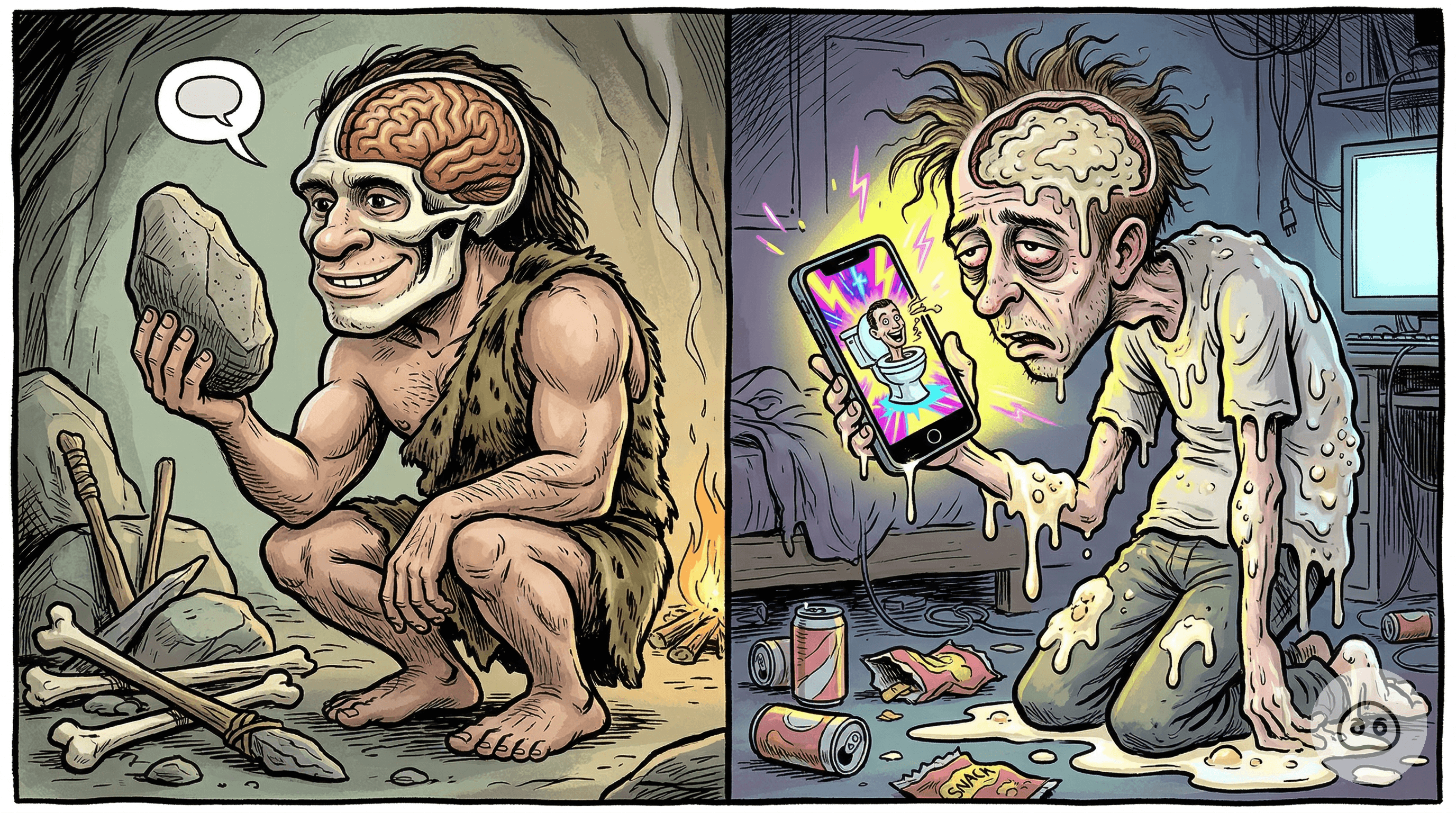
OXFORD, England (The Trough) — Lead investigators at the University of Oxford have blown the lid off a 12,000-year-old conspiracy involving the sheer structural integrity of the human mind. While the rest of a Neolithic body might crumble into the dust of history, their brains are turning up in bogs and deserts with the leathery resilience of a pair of vintage Doc Martens, primarily because they were never forced to allocate 40 percent of their processing power to understanding why a head is singing in a porcelain fixture.
The Trough has obtained exclusive data from the Paleobiological Institute suggesting that "molecular cross-linking"—the natural tanning process that turns ancient gray matter into durable bio-plastic—is physically impossible in the year 2024. Our sources indicate that the modern human mind is currently undergoing a process researchers are calling "The Great Softening," where the average neural pathway has the structural density of a lukewarm Gogurt left in a hot minivan.
"It’s a massive cover-up by the digital attention lobby," said Dr. Barnaby Glint, Senior Neuro-Archaeologist at the Institute for Sane Remnants. "The Neolithic brain was a fortress of focus, a vault of survival-based calculations. It preserved itself because it was occupied with tangible reality—flint knapping, mammoth tracking, and not dying of a tooth infection. Today, we are seeing brains that have effectively surrendered to a state of permanent liquefaction, dissolved by the acidic pH of 15-second loop videos and infinite scroll interfaces."
My investigation took me deep into the archives of the Royal Society, where I witnessed the "Preservation Paradox" firsthand. I saw a shriveled, 8,000-year-old brain from an Iron Age bog that looked like it could still handle a complex game of chess or a mid-range tribal war. In contrast, researchers showed me a recent MRI of a 19-year-old content creator; the image was just a blurry, neon-colored smudge that looked suspiciously like the loading icon on a defunct streaming service.
"The ancient brain was an offline hard drive buried in a safe," said Sarah Marrow, a Paleopathologist at the Center for Cranial Durability. "It was 'self-tanning' through sheer lack of interference. Modern brains, however, are constantly being microwaved by the 5G hum of irrelevant information. You can't turn a brain into leather when it's being blasted by three different notifications per second while a robotic voice reads a Reddit thread over Minecraft parkour footage. You just get a very expensive, very depressed soup."
The implications are staggering for the future of the species and the fossil record. While archaeologists 12,000 years from now will find the sturdy, leathery minds of our ancestors and marvel at their capacity for silence, they will find nothing of our generation but a thin, oily residue on the inside of a skull, likely smelling faintly of vape juice and desperate validation. The molecular bonds that once held human consciousness together have been systematically vibrated apart by the bass-boosted remixes of songs we don't even like.
"We are witnessing the literal melting of the human hardware," said Greg Sludge, a Digital Forensics Expert who requested anonymity to avoid being filtered by the algorithm. "The Neolithic man could track a herd for three weeks without checking his dopamine levels. If a modern human's Wi-Fi drops for three minutes, their amygdala begins a self-destruct sequence that leaves the prefrontal cortex with the consistency of a melted milkshake. There is no 'cross-linking' happening here, only a slow, rhythmic draining of the collective soul into the cloud."
The Trough’s investigation suggests that the "Skibidi Factor" is just the tip of the iceberg. The real scandal is the systematic thinning of the human skull-liner. While our ancestors were busy turning their memories into permanent geological features, we are turning ours into temporary cached files that are deleted the moment a newer, louder video of someone eating a giant pickle appears on the horizon.
"At least the ancient ones died for something," noted Dr. Glint as he packed away a brain that looked like a very smart, very durable walnut. "They died for the hunt, for the tribe, or for a particularly sharp rock. We are dying for the chance to see a CGI toilet one more time before our eyes glaze over for the final time. It's a tragedy, but at least the yogurt is sweet."
Future historians won't need shovels to study the digital age; they'll just need a straw and a very strong stomach.