
SoftBank Borrows $40 Billion From Banks To Give To OpenAI To Buy Chips From Companies Funded By SoftBank
Economists praise the closed-loop financial system, noting that the massive influx of capital will safely never have to interact with an actual consumer or a viable product.
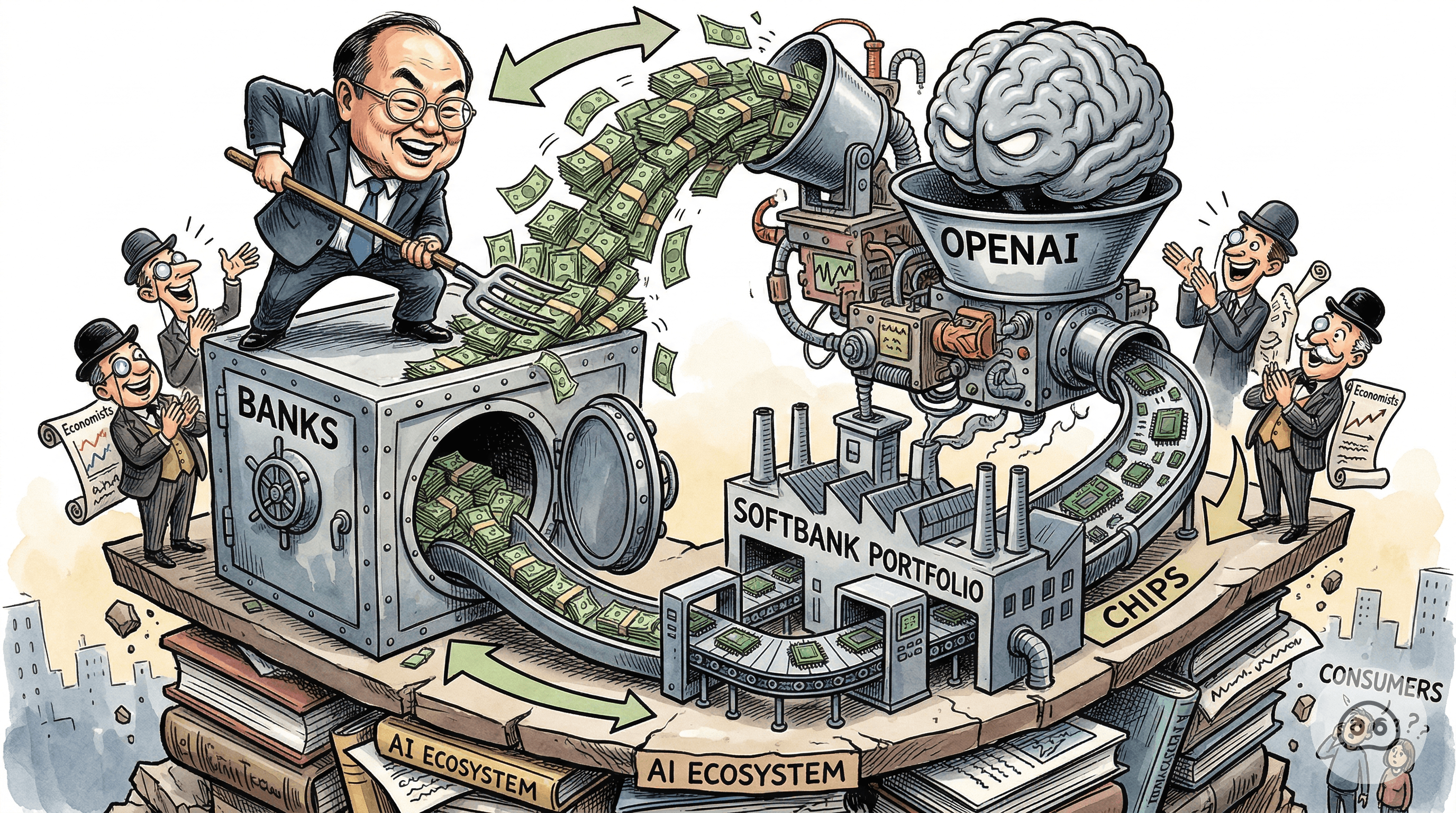
TOKYO (The Trough) — Global financial markets took a historic step forward Tuesday with the successful deployment of a fully autonomous capital vortex, allowing billions of dollars to circulate endlessly between tech conglomerates without ever risking exposure to the real economy.
The uncollateralized bridge loan allows the holding company to execute a high-velocity liquidity rotation, which is Wall Street parlance for placing a $40 billion bet on a roulette wheel that they also own. By funneling the cash into an artificial intelligence startup, which then purchases processing hardware from other entities in the holding company’s portfolio, the capital achieves perfect macroeconomic isolation.
"What we've created is a frictionless monetary ouroboros," said Arthur Penhaligon, Senior Vice President of Imaginary Equities at JPMorgan Chase. "Historically, corporate investments carried the systemic risk of eventually needing a product that a human being might want to purchase. By keeping the money strictly between our underwriting syndicate, a charismatic billionaire, and a server farm, we've mitigated the consumer variable entirely."
Lenders confirmed the $40 billion note requires zero traditional collateral, opting instead to secure the debt against the theoretical future output of a digital superintelligence that currently struggles to format a spreadsheet. Of the total sum, $10 billion has been earmarked for "general corporate breathing room," a specialized accounting term for staring at a bank balance until the existential dread subsides.
"The synergy is frankly breathtaking," noted Eleanor Vane, Chief Leverage Strategist at the Institute for Chart Extrapolation. "If we spin the capital fast enough, the friction alone should generate enough venture capital to keep the sector warm through the winter."
At press time, executives were reportedly pitching a follow-up $80 billion loan to buy back the initial $40 billion loan at a premium.